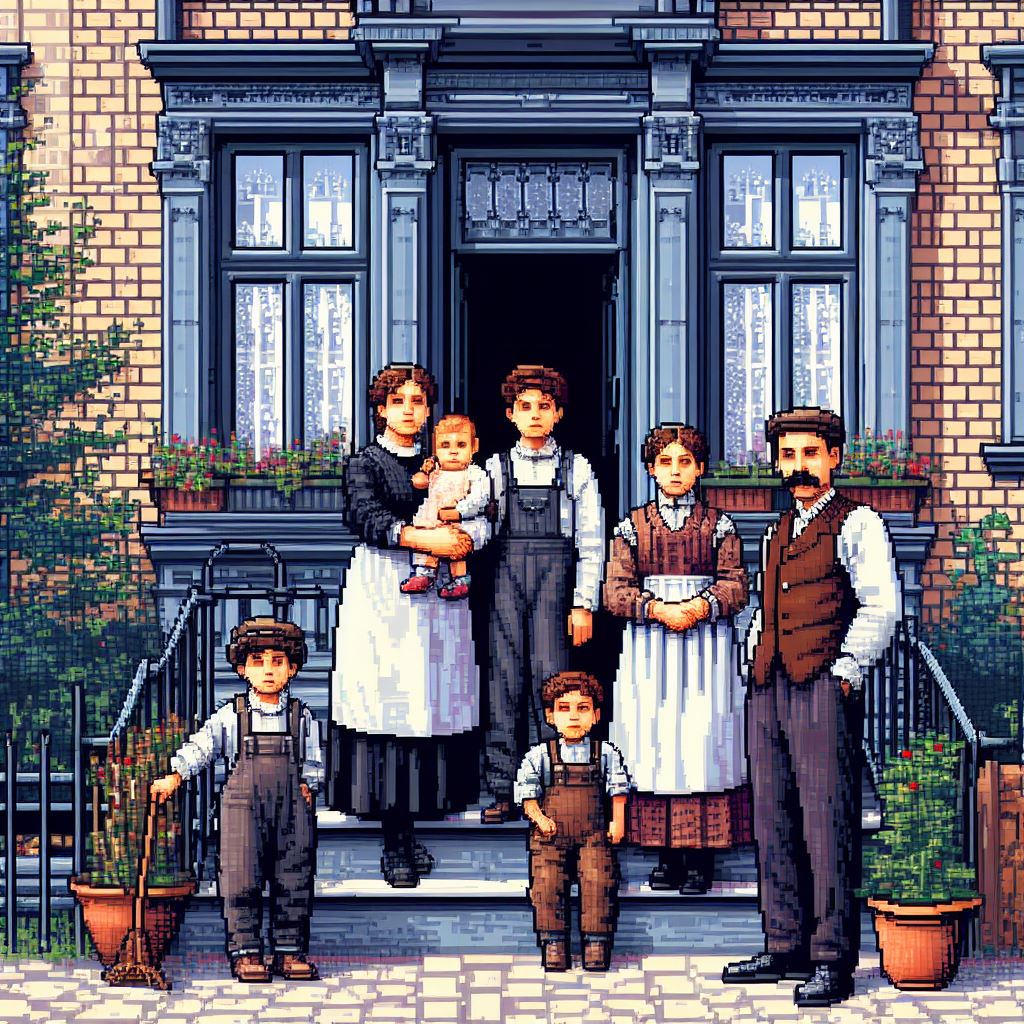
I’m from Holland. Isn’t that veird?

Family Tree 1 Comment

Here is an interesting story from my maternal line. I’ve worked on researching this, but I’ve come up empty.

Charles Van Price (Van Parijs) was born in the early 1800s and came to U.S. in 1874. He traveled to Dousman, Wisconsin in Waukesha County. He worked for Mr. Dousman, later moved to Little Chute, Wisconsin, then to Phlox, Wisconsin in 1887. While staying with his daughter, Effie, in Waukesha, Wisconsin in 1922, he went grocery shopping for her and was never seen again. After investigating, it was assumed that he returned to Holland from Milwaukee. He sold his land earlier, and was now one of the wealthiest men in that part of the state. His daughter found he had withdrawn all his savings (a very sizeable amount) and probably left for Europe. They traced him to Antwerp, Belgium — then all trace was gone. He was never heard from again.

I’ve worked on researching Belgium and Holland after 1922, but I haven’t run into anything. The main problem with Charles is that 1) Most genealogy searches don’t work well with two-word last names 2) I’m not sure if I should look for Van Price (Americanized) or Van Parijs.

I actually found the Van Parijs line by complete accident. I was looking for information on the Van Price line, but I always hit a brick wall. I had happened to find something that mentioned that “Parijs” was sometimes written as “Price” in America. So, I searched for Van Parijs and ran across a Dutch Genealogy website. It turns out that this website was a treasure trove of information from the exact area that my dutch ancestors came from, Zeeland in the Netherlands. From there I found information going back many generations.

I know that “Van Parijs” roughly translates into “of Paris” in French, so I’m wondering if this family came from France, since I have traced them back into Belgium. It just keeps going, doesn’t it?

What I’m Listening to These Days

Non-Genealogy No Comments

I thought I’d take Miriam’s challenge and do the “list the seven tracks or albums I’ve been listening to lately” post. I’m up for it, though I don’t know if I have seven people to tag afterwards. I usually aim towards rock/hard rock, but I do sometimes fall out of that genre.

Now that I’ve scared everyone off, feel free to take on my challenge by getting tagged and posting your seven.

Zalewski: It’s all in the name

Zalewski No Comments

Zalewski. Not a name you see everyday. Americanized, which is quite common. Though, not very hard to pronounce, some people just shred it because it ends in “ski.” We pronounce it zuh-loo-ski, but I’m told the original pronunciation is something like shuh-lef-ski due to the polish version of these letters.

According to a book on surnames, Zalewski comes from a topographic name for someone that lived on a flood plain or bay. (Leave it to my polish ancestors to live on a flood plain. No wonder we get a bad rap.) This is also similar to the Zaleski name, which means someone who ‘lived on the other side of wood‘. So, all I need to do now is go to Poland and check everywhere that is near water or near trees to find my surname’s origin.

Full Surname Info Page

Frank & Anna

Family Tree, Zalewski No Comments

Frank & Anna Zalewski

The farthest back I can go on my Zalewski line is to Frank & Anna Zalewski. They would be my great-great grandparents. Unfortunately, I don’t know much about this couple, except what I can gather through research and my grandmother. My grandfather passed away before I could ask him about the Zalewski family.

From what I can gather, Frank Zalewski, Sr., his wife Anna, and their two oldest children - Martha and Angeline, emigrated to the US from the Baltic port of Danzig (GdaƄsk) and arrived in Baltimore, Maryland, in about 1890. The couple’s third child, Mary, was born in Baltimore in March 1891 (Though, according to my research, the census says she was born in Ohio.) The family then traveled west to Nebraska and east, from there, to the Polish community in Chicago. (I have not yet found hard evidence of this, but this is what I received from a fellow Zalewski researcher.) By May, 1892, the family had settled in Milwaukee, Wisconsin. This is backed-up according to an interview conducted in April 1980 with Frank Gierszewski, Jr, a grandson of Frank and Anna Zalewski by the same researcher. He indicated his grandparents left Poland from the Baltic port of Danzig and entered the United States through the port of Baltimore, Maryland.

There is some confusion, however, as to the area of Poland in which Frank and Anna Zalewski resided prior to their emigration to the United States in 1890. During a telephone interview with their granddaughter, Caroline (Walczak) Sullivan, conducted in January 1995, she indicated that Frank and Anna lived somewhere in the province of Poznan — an area of Poland then under German jurisdiction and known as South Prussia. This would correspond with information supplied on the death certificate and in the newspaper obituary of Frank Zalewski, Sr in 1941. Although neither source mentions Poznan as his place of birth, both list Germany as his country of orgin. (Much of western Poland, including Poznan Province, became German territory after the three partitions of Poland at the end of the eighteenth century.)

There is, however, a conflicting story as to the area of Poland from which Frank and Anna originated. During a 1993 telephone interview with another granddaughter, Irene (Zalewski) Lutzenberger, she indicated that her late father (my great grandfather, Joseph Zalewski) had always said his parents came from eastern Poland — an area then under Russian rule. Irene’s father also stated that when his parents entered the United States, their surname was spelled “Salefsky,” thereby reflecting the Russian influence. Although no official documents can be found to verify this, it is interesting to note that in the 1934 obituary of another grandchild, Norbert Cybela, the maiden name of Norbert’s mother is spelled “Zalesky.”

It is hypothetically possible that Frank Zalewski, Sr is, indeed, born and raised in Russian Poland and, at some later point in his life, moved to the German section in which Poznan Province was located. Although traveling across political borders was difficult in 19th-century Europe, to say the least, it was not impossible. In Russian Poland, for example, all debts to the government, including military service in the czar’s army, had to be fulfilled before travel documents would be issued and borders would be crossed. Two years of active military service followed by two years in the reserve forces was required of all males when they reached their twentieth birthday. In Frank’s case, that would have accounted for the years 1878 through 1882. We know he married Anna Lindner (a German) in January 1885, which means he probably relocated from Russian-held, eastern Poland to the German-held, western area sometime between 1882 and 1884. This, of course, is only speculation but would explain the Russian “sky” ending on the surname.

I’ve spent a great deal of my research time trying to find any more information on this family. Unfortunately, getting records from 18th century Poland/Prussia is very difficult, if not impossible. As always, my hopes go out to my readers that I will run across a connection with someone else’s family. Contrary to my popular belief, Zalewski is a somewhat common name in the United States, and even Wisconsin, but I’ve not yet been able to connect my family line to any of them. I find it hard to believe that Frank was an only child, but who knows?

RootsTube

Tips & Tricks No Comments

I found a nice collection of Genealogy-related videos ala YouTube at a site called RootsTube. I watched one on “Writing Your Family History” and it was very interesting. I am linking it here, but you can watch the rest or them (and more) at their website.

Go see the rest at RootsTube. To find more videos, click on the “Change the Channel” link. It took me a bit to figure that out. via The Genealogue.

Next Entries »