Over the years, I’ve spend a lot of time looking for deaths in the archive of The Milwaukee Journal on Google News. The problem is that these entries are usually too small (or too bad of quality) that they don’t get picked up by the character-recognition software when Google put them online. This means you can’t automatically search for them. Also, depending on the date of the paper, the death may be recorded in a normal obituary, a full article (like my great-great grandfather, fortunately), a tiny single-line burial permit, or a small death notice.
So, since I obviously need more work on my genealogy plate, I decided to start recording all of the deaths I can find in these archives. I try to note the date, individual’s name, paper, type of record, age, and address. This will be put into a database where it will be searchable. So far, I’ve recorded a bit over 700 entries (some duplicates due to similar entries on multiple days) mainly from the years of 1884 and 1910. I know I’m behind on recording data for my main Zalewski project, but recording census data is a lot more difficult (especially on the technical side.)
I’ve built my transcription process to be pretty simple. It’s something I can do when I have 10-15 minutes free. I can just open an archived paper, browse through it, and fill out a small online form when I see a death. Once I hit submit, it’s already in the database and viewable online. It’s not publicly available, yet, but I hope to have it up soon. It’s not every piece of information on every death recorded in the paper. I am human and only one person. There will be items I miss or things I enter wrong, but it’s more than is out there now. The benefit is two-fold. This data will be recorded and searchable, and I will probably find information on my family somewhere. Also, who knows how long Google will keep the archives online. These papers are available elsewhere on microfilm, etc, but I’ll do what I can when I can.
Keep an eye on here to see when the data will be available. I foresee in the next week, at least for basic listing and searching.
This all started when, on a whim, I decided to see what happened in Milwaukee 100 years ago. I went to the Google News Archive site for The Milwaukee Journal and brought up the paper from March 19, 1915 (I know, I was one day off.) I read a few front-page stories and then ran across one titled, Boys Seek to Help Widowed Mother-One Loses Both Hands and the subtitle says, “Child Weeps in Hospital While Operation is Performed on Brother.” How could I not keep reading?
Click for larger
If you can’t read the article, it basically talks about two boys who went off to a train yard to collect bits of fuel (probably coal) that fell off of the trains. While running between two cars, one boy had his hands crushed between them when they moved. In the end, he had to have them amputated at the elbows.
I was now very interested in what happened to this boy, Anton Katshamer, as named in the story. I went directly to FamilySearch and tried looking for that name, but no luck. After playing with the names, spelling, and family members, I ran across a family in the 1910 Census for Milwaukee with all of the correct people; a boy named Max, a younger boy named Anton. Though, their last name was spelled, Kopfhammer. I then found the family in the 1920 Census. This time without a father, which lines up directly with the story that mentions “the father has been dead three years,” so in 1912.
I went to our trusty friend, Google, to try to find more. My search for Anton brought up 3 more articles from The Milwaukee Journal from later in 1915. The first one, from April 10, 1915, is titled Workers Help Fund For Tony. It mentions how a few local companies and individuals put together some money for Anton and his family, totaling $2,318 in this article, including a man who sent in his 35 cents that he saved by skipping his noon meal.
The second one from later in April on the 20th, titled Guardian Named For Boy Who Lost Hands. It mainly talks about who took over Anton’s guardianship while he works on learning to live without hands, including, hopefully, getting artificial hands.
The last one from December 1915 is titled Injured Boy Gets $15,000 in Court. $3,000 of that came from the local businesses and individuals and $12,000 came from the railroad company, though without involving a lawsuit. There are some funny quotes from Anton in this article.
“I don’t know what I will be when I grow up to be a man,” continued Tony, “I can’t be a fireman or policeman, and I might be a lawyer. They have been nice to me.”
It was suggested that Tony would not be a howling success as an attorney without hands, as one of the great requisites for financial success is five flexible digits on each manual extremity.
I also found a death record for an Anton Kopfhammer matching the dates from California in 1989, though no luck on obituaries or more information. I’d really like to see what he became when he grew up. I’ll keep you posted if I find anything more. It’s amazing what information you can find with the records available today.
Besides genealogy, one of my other enjoyments is video games. For people who don’t really dabble much in video games, which is probably a lot of the genealogy community based on demographics, they probably think it’s just a wastes my time and rots my brain. While, in some cases, it probably does, in other cases it makes me learn about the history of the world by letting me get involved in that history.
Two games from Paradox Interactive have sucked up almost all of my free gaming time (which, with 2 kids, is not a lot.) They are Crusader Kings II and Europa Universalis IV and are described as “grand strategy” games.
Crusader Kings II
The first, Crusader Kings II, which my brain is stuck to at the moment, is described: “[explore] one of the defining periods in world history in an experience crafted by the masters of Grand Strategy. Medieval Europe is brought to life in this epic title rife with rich strategic and tactical depth.” You can choose any one of hundreds of noblemen anywhere from 867 to about 1453. Start with a king and rule your minions, or start with a count and work your way up to emperor, if that’s your thing. There is really no goal to the game, it’s basically a sandbox. Each time your character dies, you begin to play as their heir. Do what you want, the only important thing is to continue your dynasty by having heirs because once you run out of bloodline heirs, your game is over (or it hits 1453.)
Europa Universalis IV is similar to CKII as it’s a grand strategy game, but instead of controlling people, in EUIV, you control a country.
The empire building game Europa Universalis IV gives you control of a nation to guide through the years in order to create a dominant global empire. Rule your nation through the centuries, with unparalleled freedom, depth and historical accuracy. True exploration, trade, warfare and diplomacy will be brought to life in this epic title rife with rich strategic and tactical depth.
Though, in EUIV you can literally pick any country in the world from 11 November 1444 A.D. (the day after the crushing defeat of the Poles and Hungarians by the Ottoman Turks at the Battle of Varna, and the death of King W?adys?aw III of Poland), and ending 1 January 1821 A.D. I put less time into this one so far, but it has been out for less time. It’s a different style that CKII. You deal more in colonization or trade or warfare and expanding your country around the world. In CKII, you deal more with people and expanding your kingdom through marriage, intrigue, and clever relationships while at the same time watching your back. It’s like a world-wide soap opera.
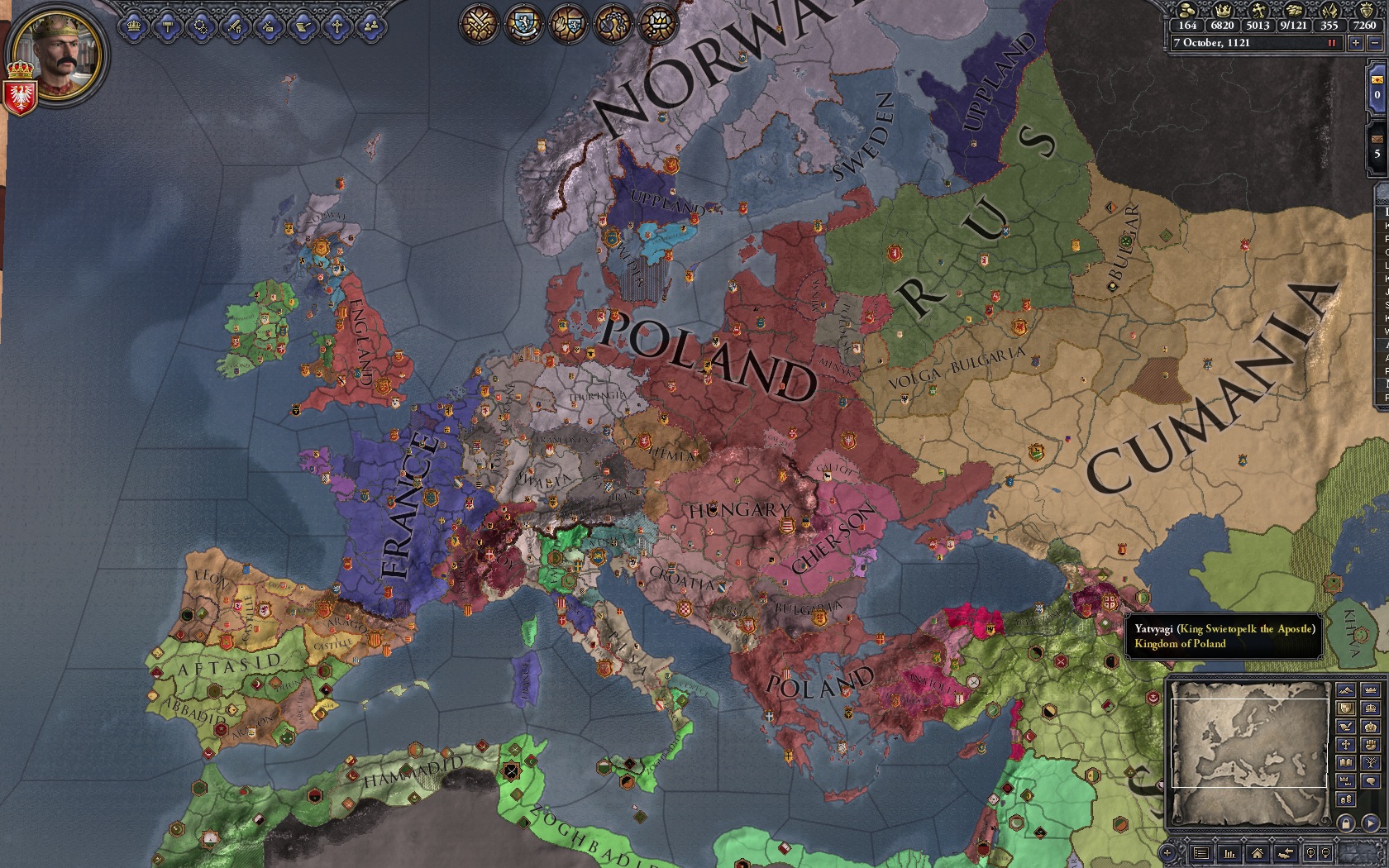
Though, these games have a pretty steep learning curve, but once you get into them they are tons of fun. Once you hit the play button, you are creating an alternate history for the world. For example, here is one of my first play-throughs of Crusader Kings II that I talked about on our entertainment/gaming site.
I started as King Boles?aw II of Poland and it went pretty smooth during his reign. He lived to be pretty old, even by today’s standards, dying at 82. That’s when everything fell apart. My new heir was the King’s first born son, Franciszek, though he did not inherit everything because the succession laws in Poland were “Gavelkind.” That law gives the first heir the major titles and then equally spreads the rest to the other heirs (male in this case.) So, Franciszek’s half-brother, Josef, decided to declare war on me for his claim to the Kingdom of Poland. He won, due to having many allies.
It didn’t last long as his brother, Roman, went to war with him for the kingdom also, imprisoning him in the process and taking over. More people started wars. In the end, or as it stands in my game right now, Roman is dead, Josef is a Polish Duke, their sister Elisabeth is now Queen of Poland, and I’m down to being a Count with one county, but still alive and scheming including secretly murdering two other Counts. Though Franciszek is no longer my character, his son the heir is now my character. Sadly, one of his main traits is “imbecile” so he’s a really bad ruler. He has no bloodline heir since he’s only 15, so my goal is to get him a son before he dies or gets assassinated.
And that was back when I wasn’t very good at it. You learn as you play and from your mistakes. I learn a lot of tips from “Let’s Play” YouTube videos. Every time you play, it is completely different. My most recent play through with Poland, King Boles?aw died in his 30s with only a single daughter, but she reigned for a long time as Queen Helena the Ironside. After that, it sort of fell apart after the Holy Roman Empire went to war with me for his vassal, the Kingdom of Bohemia and I had to surrender most of Poland to Bohemia. Currently, I am ruling as the King of Denmark, which somehow came to my dynasty through clever marriages and deaths.
Not only is it enjoyable, but I’ve learned a lot more about the history of the world during these times. You can play from 867 with Crusader Kings II and when it ends in 1453, you can convert your game over to Europa Universalis IV and then play until 1821. That’s almost 1000 years. What kind of world will it be then? I bet your family history would be very different.
History and documentation has always hinted that my great-granduncle, Frank Zalewski, Jr, the brother of my great-grandfather, Joseph, never married, never had children. There was never any mention of a wife, anywhere, and he was buried with his parents, Frank & Anna, when he died in 1976. I, surprisingly, can’t find his obituary in the Milwaukee Sentinel archives from November 1976. The Milwaukee Journal does not have any editions during that time available online.
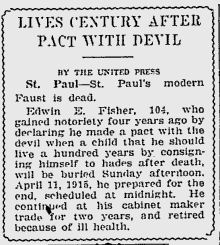
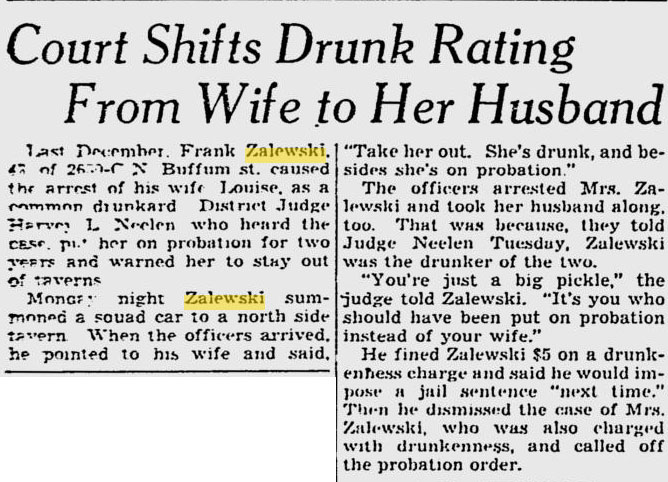
One day, while browsing through the Milwaukee Journal archives at Google News, I ran across an interesting news story.
The title of the article didn’t surprise me much. I picked up, through the years of research, that Frank, Jr seemed to never really “amount to much” in his life. There seemed to never be a lot of mention of him or photos of him. He seemed to be the black sheep of this Zalewski family. A far cry from his older brother, Joseph, who was a WWI veteran and a 33-year veteran of the Milwaukee Police Department. Though, according to the article, it seemed his wife wasn’t much better. That was the key to all of this. It says, “his wife Louise.” I’m almost certain this is Frank, Jr since his age matches up exactly, and this is the same address he lived at when his father died in 1941. I also found him in the 1940 Milwaukee City Directory at the same address, listed as “Frank E jr (Louise K).”
The funny thing is, I can’t find any mention of this marriage (though, by the looks of it, it probably didn’t last much longer) in any records. I’m pretty sure Frank, Jr is always listed as “Single.” Though, come April 2nd, when the 1940 Census comes out, it looks like he was married according to the City Directory. Maybe that will shed some light on the subject.
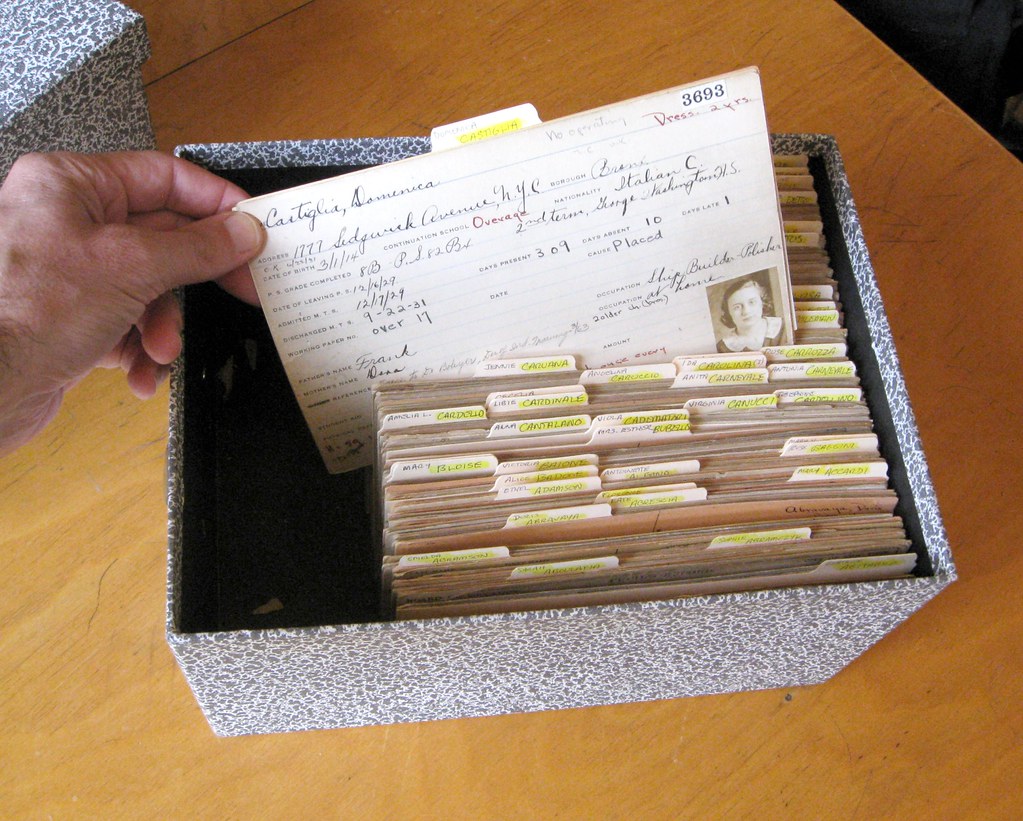
A few weeks back, I ran across a link on BoingBoing to an article on Slate.com. I saw that it mentioned old documents and since I’m a sucker for old documents, I gave it a read. If you’re also a fan of old documents, especially more interesting ones, than you’ll love this series of articles on a collection of old report cards and how the author used them to not only tell the history of these people, but to even connect them back to their descendants.
Four hundred little dramas, all sketched out on cardstock. Marie’s report card comes from a large batch of old Manhattan Trade School student records that I stumbled upon more than a decade ago and have been obsessed with ever since. I’ve spent a good chunk of my life poking around antiques shops, yard sales, and abandoned buildings, but these report cards are by far the most evocative, most compelling, and most addictive artifacts I’ve ever come across.
This sounds like something I would do if I ever ran across a batch of old documents. I’ve learned in the last decade of family research that sometimes you can find the most compelling information in your non-standard documents. “Non-standard” being something other than things like census or vital records. Not only do these records give you more information, sometimes they tell you stories. I personally find that stories make your ancestors seem more alive. More than just names and dates.
To anyone interested in history and even family history, I recommend reading his articles. He wrote (as of right now) 5 articles relating to these documents, so make sure you have some time.
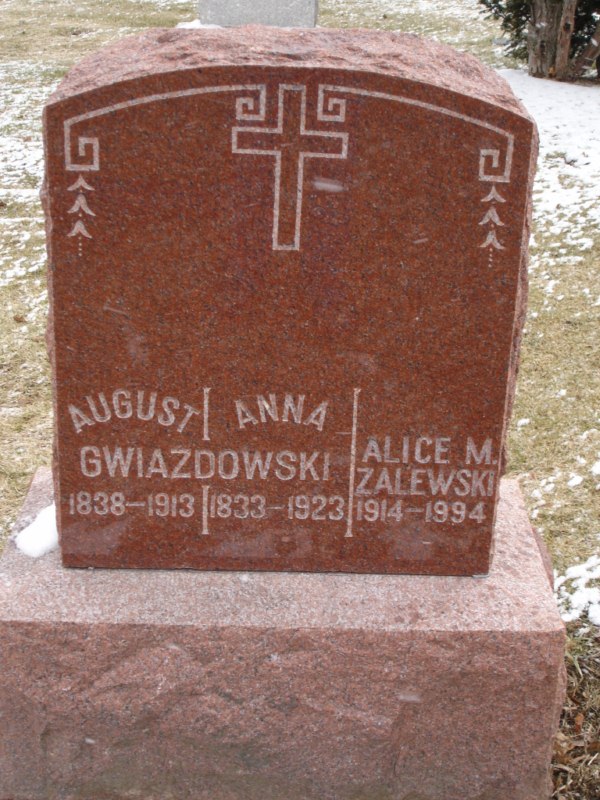
Anyone following the latest research into my ZALEWSKI line knows that I’ve run across the GWIAZDOWSKI surname on a few occasions. They have something to do with my ZALEWSKI family, but I’m still not 100% sure what it is. Research points to many conflicting options: These are Frank ZALEWSKI’s parents, these are Frank’s aunt and uncle, or maybe they’re just good friends. I have more research to do with the Polish/German church records I recently found at the FHL.
Above: More evidence that they’re related to me somehow is that (among other things) they’re buried with members of the Jacob ZALEWSKI family (the brother of Frank) at Holy Cross Cemetery in Milwaukee, Wisconsin. Their plot is located at the back part of the GORALSKI stone (another family somehow related to me.)
Amanuensis Monday ““ An Amanuensis is a person employed to write what another dictates or to copy what has been written by another. Amanuensis Monday is a daily blogging theme which encourages the family historian to transcribe family letters, journals, audiotapes, and other historical artifacts. Not only do the documents contain genealogical information, the words breathe life into kin ““ some we never met ““ others we see a time in their life before we knew them. A fuller explanation can be found here.
I’ve posted about this letter in the past, but I thought I’d talk about it again. I have possession of some typewritten letters that my great granduncle, Edwin Corrigan, wrote to another relative. My grandmother must have had them in her possession since I have a lot of her old family documents. Edwin was born in 1909 and grew up in rural northern Wisconsin in the Ashland area. He was a well-traveled and bright man and he had seen a lot of things. The letter is a great insight both into life in the early 20th century (in rural Wisconsin and other similar places) and also other aspects of his life. Read on for some excerpts:
Well, after over a decade of doing genealogy research, I finally made a trip to one of the “local” Family History Libraries. I put local in quotes, because it was still a good 30 miles away, but not too far. I’m not exactly sure why I never visited one. I like knowing how things work before I go since I hate being somewhere and not knowing how to act. For example, I had my iPhone with me, but hidden in my pocket since I wasn’t sure the rules on electronics/cameras. I wasn’t even sure if I could use a pen and paper. Some places are strict in that regard. Later on in the day I saw a man using a laptop right next to a microfilm reader, so now I know.
I just wanted to make a quick trip and look over the records they had on “perpetual” loan. The lady who showed me around seemed confused when I said that, though all of the records I used said that they were on “indefinite” loan, so I’m sure it’s the same thing. They have all of the Milwaukee church records and vital records on-hand. I really wanted to look through the church records for both St. Hedwig’s and St. Casimir’s churches on the east side of Milwaukee since those two are where most of my Polish family attended. My main ZALEWSKI ancestors first went to Hedwig’s and then Casimir’s when they moved.
I was also really hoping to find the marriage record of Frank ZALEWSKI’s brother, Jacob to his wife Pauline WONDKOWSKI. I am somewhat lucky in the fact that Jacob was unmarried when he immigrated. This should hopefully allow me to find his marriage record and maybe his parent’s names (which would also be Frank’s parents, my 3rd-great-grandparents.) As luck would (not) have it, I couldn’t find the record. Jacob and Pauline baptised all of their children at St. Hedwig’s, but I could not find their marriage record. I looked countless times going back and forward a few years, too. It is possible that they may have been married at another church in the area, which I will pursue or there is a very rare possibility that they married elsewhere before coming to Milwaukee, which would not be fun to track down. Plus, I also found many spellings of Pauline’s last name, from WADKOWSKI to LUTKOWSKI.
I did, again, solidify the relationship between the ZALEWSKI, GWIAZDOWSKI, and GORALSKI families. A lot of both Frank’s and Jacob’s children were sponsored by one or more of the families. Frank and Anna ZALEWSKI’s last child, Agnes, was sponsored by both August and Anna GWIAZDOWSKI. It also seems that in some of the earlier baptism records, they listed the female sponsors with their maiden names as I found Pauline listed as Pauline LANDKOWSKA on my great-grandfather Joseph’s baptism record (which I posted about earlier this week.) Also, on their next child, Frances Dorothy ZALEWSKI, I found the female sponsor listed as Maria GWIAZDOWSKI, better known as Mary GORALSKI, which now (somewhat) proves that she is the daughter of both August & Anna, though it still messes up the fact that she is listed as Frank ZALEWSKI’s sister.
I also found some other possible family connections that I need to pursue, mainly on the LINDNER side, though some on the TROKA side, too. I ordered the records from what I hope is the original location of my ZALEWSKI and LINDNER ancestors, Gocza?ki (or more specifically, the parish of ÅšwiÄ™te.) We’ll see how that turns out once the records arrive, usually in about 6 weeks.
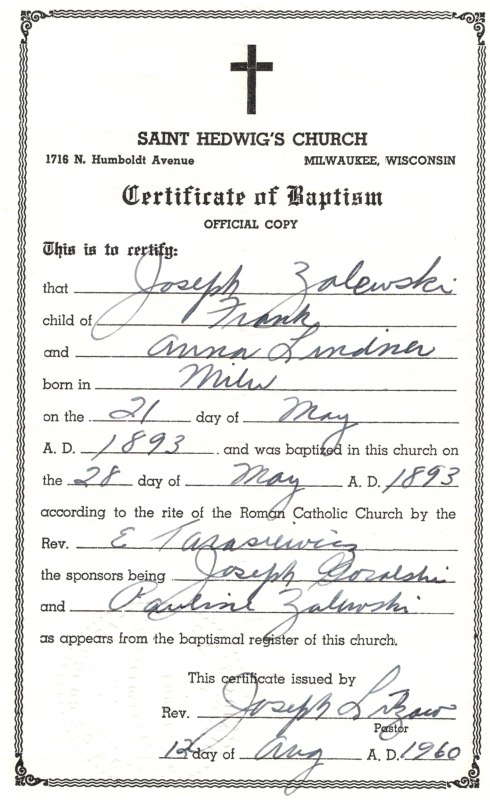
While looking for some other documents, I ran across a record that again pretty much seals the fact that my great-great-grandfather, Frank J Zalewski, and the Jacob Zalewski I have been researching were brothers (or worst case, cousins of some sort.) Below is my great-grandfather, Joseph Zalewski’s, “Certificate of Baptism” from St. Hedwig’s Church in Milwaukee. The document itself is from 1960, but the information is probably taken directly from the church’s records.
Click for larger
The part that interested me on this specific item was the list of “sponsors.” It lists Joseph GORALSKI and Pauline ZALEWSKI. Joseph has been mentioned a lot recently along with the GWIAZDOWSKI’s. Pauline is Jacob’s wife and probably Joseph’s aunt. Mary may also be Joseph’s aunt, if her obituary is to be believed.
I probably didn’t pick the best day to do some more research at Holy Cross Cemetery in Milwaukee today. A wonderful “spring” day in Wisconsin, a windy 23 degrees with snow flurries. I also should have probably worn more than a sweatshirt, but it wasn’t all that bad. I did have a knit cap on.
Last night I made a list of all of the headstones I wanted to find at the cemetery, including some I already had. I wanted to get better quality photos. Well, the small list turned into two pages of entries, about 55 total. Thanks to the Archdiocese website, I was able to map (the general area) of where the stones were. I hit up the stones I really wanted to find first, the Gwiazdowski, Goralski, and Jacob Zalewski family. Once I found the section and started to walk the graves, I cursed myself for not wearing a larger coat. Though, once I found the collection of stones I forgot about the cold.
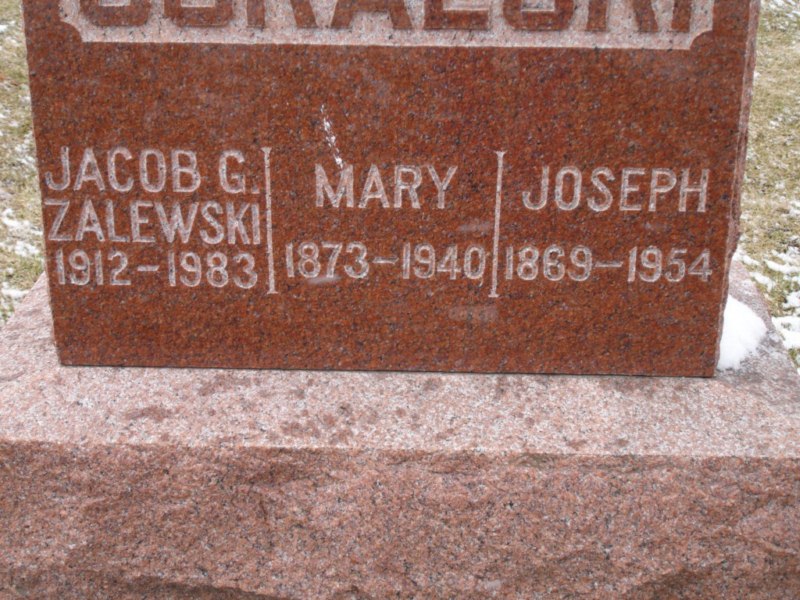
All of the stones were in one area in the middle of Block 4B. I caught the “Goralski” name on one of the large stones while walking. The way the graves were set up mostly solidifies the Gwiazdowski/Goralski/Zalewski connection, because Jacob Zalewski, Jr and his wife were on the same stone as the Goralski’s and Gwiazdowski’s. I know it’s not proof, but there are few reasons why else they would be on the same stone.
Joseph & Mary Goralski with Jacob Zalewski, Jr - Click for larger
On the other side of this stone are August & Anna GWIAZDOWSKI and Jacob’s wife, Alice. That’s another notch in the connection that Mary is August & Anna’s daughter. Jacob, Sr & Pauline ZALEWSKI, along with their son Edward and his wife Kathryn were on the next headstone to the south.
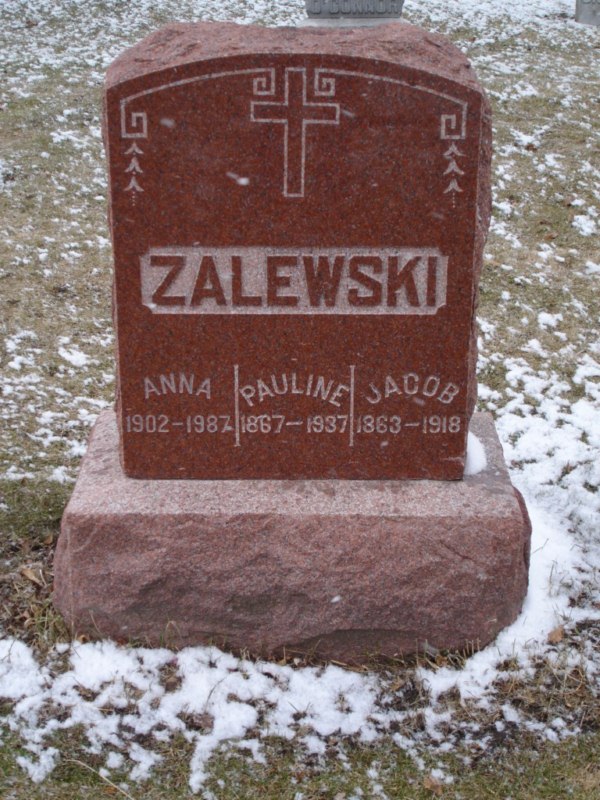
Jacob & Pauline Zalewski, with daughter Anna. Edward and his wife Kathryn are on the other side. - Click for larger
Unfortunately, there wasn’t much but dates on the stones. I was hoping maybe for maiden names or birth places. It’s still more proof and it’s nice to finally visit their final resting place. I didn’t get to my whole list since the other sections were mostly all flat headstones and I didn’t want to have to walk in the snow and cold to try to find them. Even though I had pinpointed it to Section, Lot, and Grave number, it was hard to figure out where the specific Lots were.
I’ll come back later and get those photos once it’s actually spring here. My dad said he would also like to tag along, but he wasn’t feeling well today and it wasn’t a very pleasant day to go anyway.
This is a video from San Francisco supposedly taken only a few days before the 1906 earthquake and fire. It has been seen before, as it noted in the post over at BoingBoing, where I saw it, though this version is of much better quality. Also, the original video can be downloaded in high-quality since it’s in the public domain. If you want that, you can go on over to archive.org and get it.
I think it’s amazing to see how life was back in 1906. Note the almost-chaotic driving, the people hitching rides on seemingly random vehicles, the mix of horses, people, and cars. (Sorry, it’s a bit cut off, but you can see most of it.)
 Over the years, I’ve spend a lot of time looking for deaths in the archive of The Milwaukee Journal on Google News. The problem is that these entries are usually too small (or too bad of quality) that they don’t get picked up by the character-recognition software when Google put them online. This means you can’t automatically search for them. Also, depending on the date of the paper, the death may be recorded in a normal obituary, a full article (like my great-great grandfather, fortunately), a tiny single-line burial permit, or a small death notice.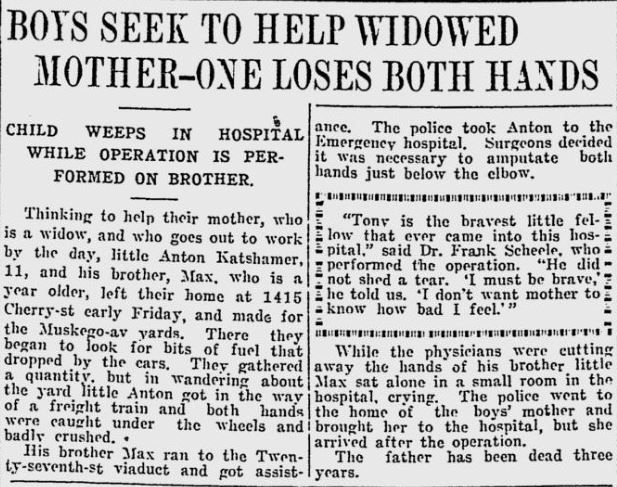
 A few weeks back, I ran across a link on